How Magnetic Racks Improve Nucleic Acid Purification Workflows
Magnetic Racks in DNA and RNA Extraction Workflows
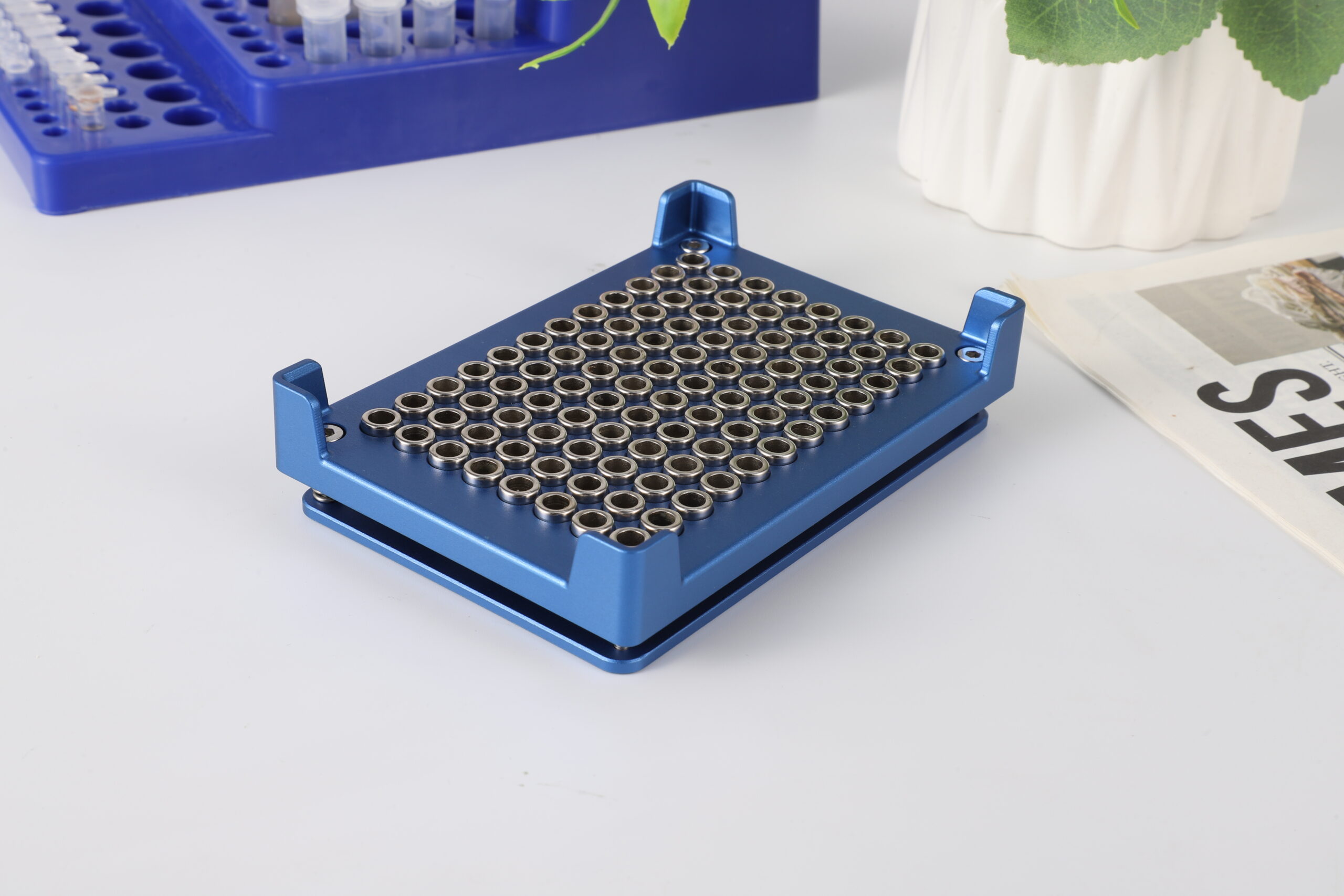
Magnetic Rack for 384 Well Plates: High-Throughput Sample Processing
In modern molecular biology and genomics research, high-throughput processing is no longer a luxury—it’s a necessity. With applications ranging from next-generation sequencing (NGS) to large-scale PCR screening, laboratories require tools that can handle hundreds or even thousands of samples efficiently. One such tool is the magnetic rack for 384 well plates, designed to streamline bead-based nucleic acid and protein purification at scale.
What is a 384 Well Magnetic Rack?
A 384 well magnetic rack is a separation device equipped with powerful magnets aligned to the format of a 384 well microplate. It is specifically designed to immobilize magnetic beads in each well, allowing rapid and efficient separation of bound nucleic acids, proteins, or other biomolecules from supernatants.
Unlike smaller formats such as 96 well racks, the 384 well design supports ultra-high-throughput applications, making it ideal for sequencing core facilities, diagnostic labs, and large-scale screening centers.
Why Choose 384 Well Format?
-
High-Throughput Capability
-
Process up to 384 samples simultaneously.
-
Accelerates workflows such as PCR cleanup, RNA/DNA purification, and library prep.
-
-
Automation Friendly
-
Fully compatible with robotic liquid handling systems.
-
Reduces manual pipetting errors and variability.
-
-
Consistency & Reproducibility
-
Uniform magnetic capture across all wells.
-
Ensures reliable results for sequencing and quantitative assays.
-
-
Space & Cost Efficiency
-
Higher density format means more samples per plate, reducing consumables and handling time.
-
Applications of 384 Well Magnetic Racks
-
Next-Generation Sequencing (NGS) – High-throughput DNA and RNA library preparation.
-
PCR Product Cleanup – Efficient removal of primers, nucleotides, and enzymes.
-
RNA Purification – Processing of multiple biological samples simultaneously.
-
Protein Purification & Immunoassays – Magnetic bead-based capture and elution.
-
Drug Screening & Diagnostics – Large-scale assays requiring reproducible separation.
Key Features to Look For
When selecting a 384 well magnetic rack, consider the following factors:
-
Magnet Strength & Alignment – Ensures rapid bead capture with minimal sample loss.
-
Plate Compatibility – Designed for standard SBS-format 384 well plates.
-
Ease of Integration – Works with both manual workflows and automated platforms.
-
Durability – Made from high-quality, chemical-resistant materials.
Benefits for Modern Laboratories
By adopting a 384 well magnetic rack, laboratories can:
-
Shorten turnaround times for nucleic acid purification.
-
Scale experiments efficiently without compromising data quality.
-
Reduce labor costs by integrating with automation systems.
-
Improve reproducibility—a critical factor for regulated industries and research labs.
Final Thoughts
The magnetic rack for 384 well plates is a cornerstone tool for any laboratory engaged in high-throughput molecular biology or genomics. With its ability to support fast, scalable, and reliable bead-based separations, it enables researchers to meet the growing demand for large-scale experiments—whether in sequencing facilities, biotech R&D, or clinical diagnostics.